
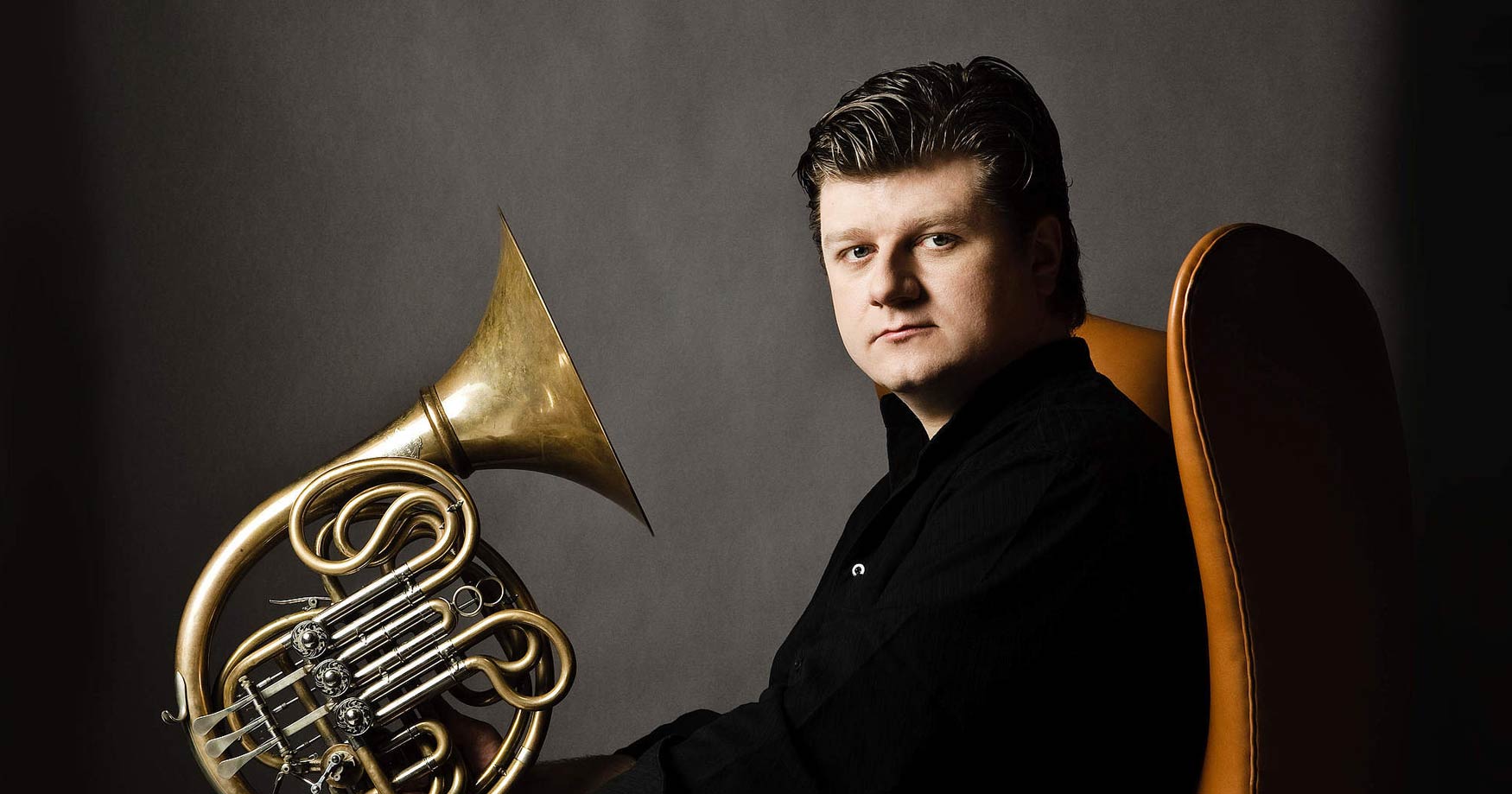
PARMA Recordings is pleased to present a new featured recording opportunity with internationally acclaimed horn soloist Radek Baborák, one of the most distinguished figures on the global classical stage.
This opportunity invites composers to record original compositions for horn (solo or in chamber settings) alongside Baborák and his hand-picked collaborators at Prague’s Studio Martínek, culminating in a professionally produced album release and public concert in 2026.
Learn more about the opportunity and submit your music at the link below, and read to the end for an exclusive interview with Baborák.

About Radek Baborák
If you do a search for Top French Horn players of all time, you’ll be hard pressed to find many lists which don’t include his name.
Radek Baborák is a celebrated performer and educator with over 35 years of international experience. He has performed as a soloist with the Berlin and Vienna Philharmonic Orchestras, under leading conductors such as Simon Rattle, Daniel Barenboim, Seiji Ozawa, and John Eliot Gardiner. His extensive experience as both horn soloist and conductor brings an unparalleled level of artistry and insight to every project he leads.
He is also the founder of the Baborak Ensemble and the Czech Sinfonietta, and serves as artistic director of the Prague Chamber Soloists. A visiting professor at the Barenboim-Said Academy in Berlin, he remains deeply committed to chamber music, education, and contemporary repertoire.
“Principal horn Radek Baborák had melted our hearts with his great, arching solo in the gracious third movement of Brahms’s third symphony.”
“I wonder whether Baborák’s performance… may have offered the finest horn playing I have heard. I can safely say that I have heard none finer.”
“Baborák is easily one of the world’s best horn players.”
We recently connected with Baborák to learn more about his artistic origins and extensive experience in performing contemporary music.
Your musical journey with the horn dates all the way back to your youth, at just eight years old. What have been your biggest inspirations along the way, and what brings you the most excitement as a performer of classical music today?
Radek: I was surrounded by music from childhood. Our whole family played different musical instruments and I spent every day, even weekends, in music school. My education was naturally multi-component — so not just the horn lessons themselves, but a number of different ensembles, such as a wind quintet, a horn sextet and other various combinations, and of course, a wind orchestra. I also played drums there. So it was not just about classical music but about different genres of music. This diversity has remained with me and has become both an inspiration and an engine that drives my love and devotion to music as a whole. I think it is a challenge for pro musicians not to lose the joy of music and to always have the desire to discover both unknown compositions and new ones.
Where/when did your love for contemporary classical begin? Is there an aspect of modern repertoire, and/or the voices of today’s composers, that particularly resonates with you?
Radek: My first teacher, Prof. Karel Křenek, made sure that I actively got to know contemporary music and taught me how to play it, how to think about it, and how to interpret it convincingly. I participated in many competitions where I usually won prizes for my interpretation of contemporary music. It was the compositions for solo horn that I played and continue to play that gave me a new impetus on how to perceive the sound and how to work with time so that new compositions are interesting for the audience and, like the works of masters of the past, make them amazed.
Later, at the Conservatory, I studied composition for one year with Prof. Řehor, and although I did not become a composer, I feel obliged to write cadenzas for solo concertos, as well as encores and occasional arrangements. Just as it used to be when much was expected of the performers. When I started conducting, I was very happy to take on the task of premiering or performing works by living composers. In my opinion, it is also a certain duty of every musician — to perceive music as something that has a past, present, and future. And it will show which songs will become part of the repertoire.
I firmly believe that if I, as a performer, understand the meaning of new compositions, I can then play them in such a way that the audience will enjoy them. And that is what attracts me and what resonates within me when I study new pieces.