
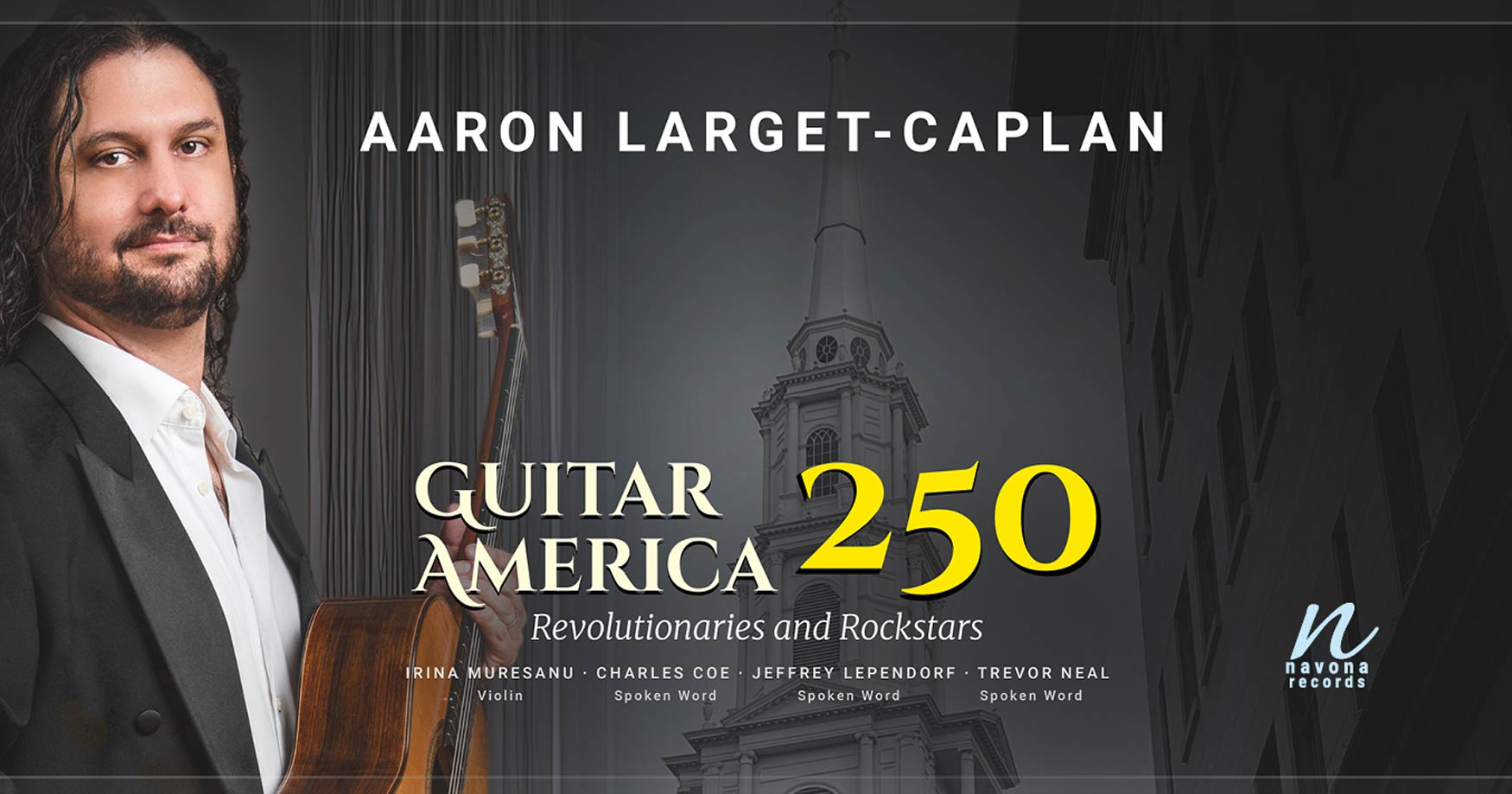
Two and a half centuries of America are commemorated by guitarist Aaron Larget-Caplan on GUITAR AMERICA 250, an exploration of the United States’ musical history. Larget-Caplan journeys through the soundscapes of a diverse nation, exploring its ideals and contradictions, and its reinventions and dreams.
To punctuate the music and further explore the foundations of America, the album includes spoken texts for two poems, an essay, and a poetic interpretation of the Bill of Rights.
Larget-Caplan is a composer, international recording and touring classical guitarist, award winning curator, producer, publisher, and instructor. His celebration of America’s semiquincentennial has garnered rave reviews, with The Arts Fuse praising the “command of both his instrument’s capabilities and his materials,” and Take Effect calling the album “an eloquent commemoration.”
See a sneak peek of the album’s repertoire.
We caught up with Aaron to get a behind-the-scenes look at this album, and the artistic journey that led to its release on Navona Records.
What was your inspiration to embark on this celebration of America’s 250th through sound?
The premise and ideals of the United States. I found myself inspired by the American stories of the composers, some of whom were abolitionists and suffragists, many were immigrants, a few social revolutionaries, and a couple rockstars.
What inspired them to write music and words they did, makes me reflect on my place in America’s history. I also saw it as an opportunity to create some “American” repertoire through arrangements and commissions of what is a very much dominated by European and Latin American composers.
Like many American guitarists, my path to classical guitar and its repertoire started with Rock, so being part of the American story, I thought it would be honest to include music of my life, hence the Paul Simon and Eddie Van Halen.
What makes American music unique? What characteristics speak to you?
There isn’t one “American” music as there isn’t one American story. It changes by region, era, and the immigrants who came to that area.
When speaking about Classical Music, as opposed to Folk music, I am drawn to the spaciousness of John Cage and Morton Feldman, the playfulness of George Gershwin and Leonard Bernstein, and the melodic line of Florence Price and Irving Berlin.
I also sought out works that represent an American story. David Liptak’s Freight – After Elizabeth Cotton, Ian Wiese’s Midnight Train, and Paul Simon’s America are examples of this. Growing up out west and living in Boston, trains, subways, and road trips are quintessentially American. Elizabeth Cotton’s story is also, for better or worse, an American story.
This is my second album to include John Cage, who to me, is the most influential American composer in the second half of the 20th century.
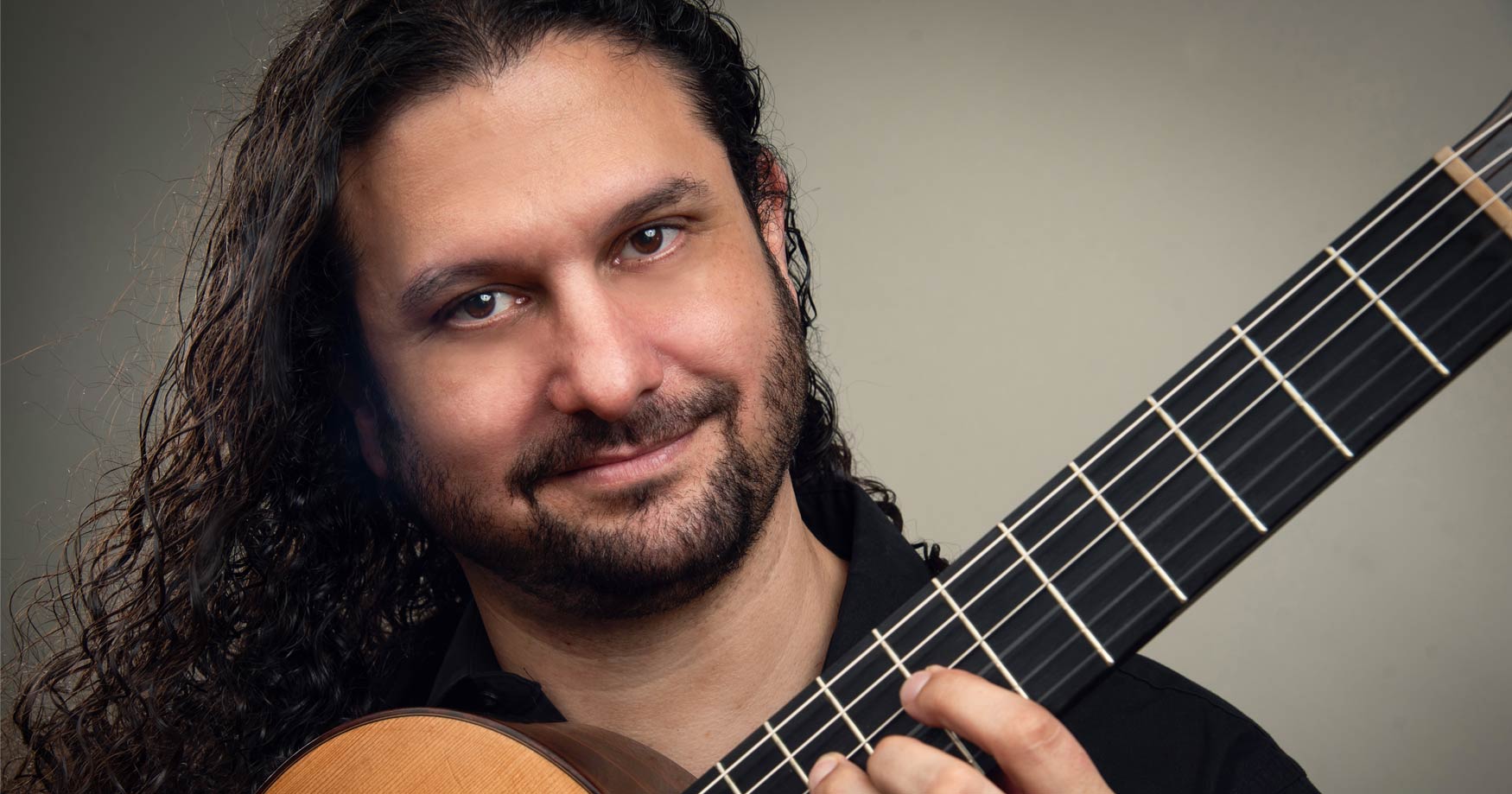
What was your introduction to classical guitar repertoire? Were you immediately hooked or was it a gradual growth of appreciation?
My first experience with classical guitar was in my high school Spanish class at the end of my junior year. The teacher played a video of Alicia de Larrocha, Victoria de los Angeles, and Andres Segovia, the latter playing Asturias by Isaac Albéniz. I went home, dropped my pic, and started using my right hand.
I worked odd jobs and bussing tables over that summer to buy a classical guitar and sought out a teacher. I played some duets with my teacher at the Tabor Opera House in Leadville CO and a short solo recital soon after. I was immediately hooked and still am.
How does being based in Boston, a historic city with deep ties to America’s roots, inform your work?
One can’t be in Boston and not be aware of its place in American history, at least the major events. There is always some lesson to be learned. I love learning about the stories of regular people and the transformation of the city itself both physically and spiritually.
Having access to so many schools of music for concerts and lectures is quite inspiring. Classical music is wonderful at archiving, but here and there are pockets of musicians who are pushing the boundaries of music and their instruments, which is what inspires me. Boston is more forward thinking for piano, chamber music, and orchestra than for classical guitar. But we work each day to improve that.
Your album covers a wide gamut of American music. What current trends are you most interested in? Where do you see American music headed in the next 250 years?
I’m interested in composers who can mix the many influences of their lives into classical works without being cliché or one-dimensional self-portraits. I like having to think and be challenged by what I hear. Truly, I’m quite interested in seeing Ai die a quick and painful death.
I love recordings, I have 12 solo albums, but I would love to see people learning how to physically make sound on an instrument and train their ears to write music. Sadly, I don’t see that happening.
There are pockets where people will continue to push the boundaries, but I don’t see institutional support for that. The basic music education is disappearing, the financial incentive is gone, and the cachet of the Arts as worthy to benefactors no longer exists. 250 years: that’s beyond my scope.

Let Freedom Ring
Explore more classical music honoring the heritage of America in our “Let Freedom Ring” Playlist, featuring new additions from Aaron Larget-Caplan.