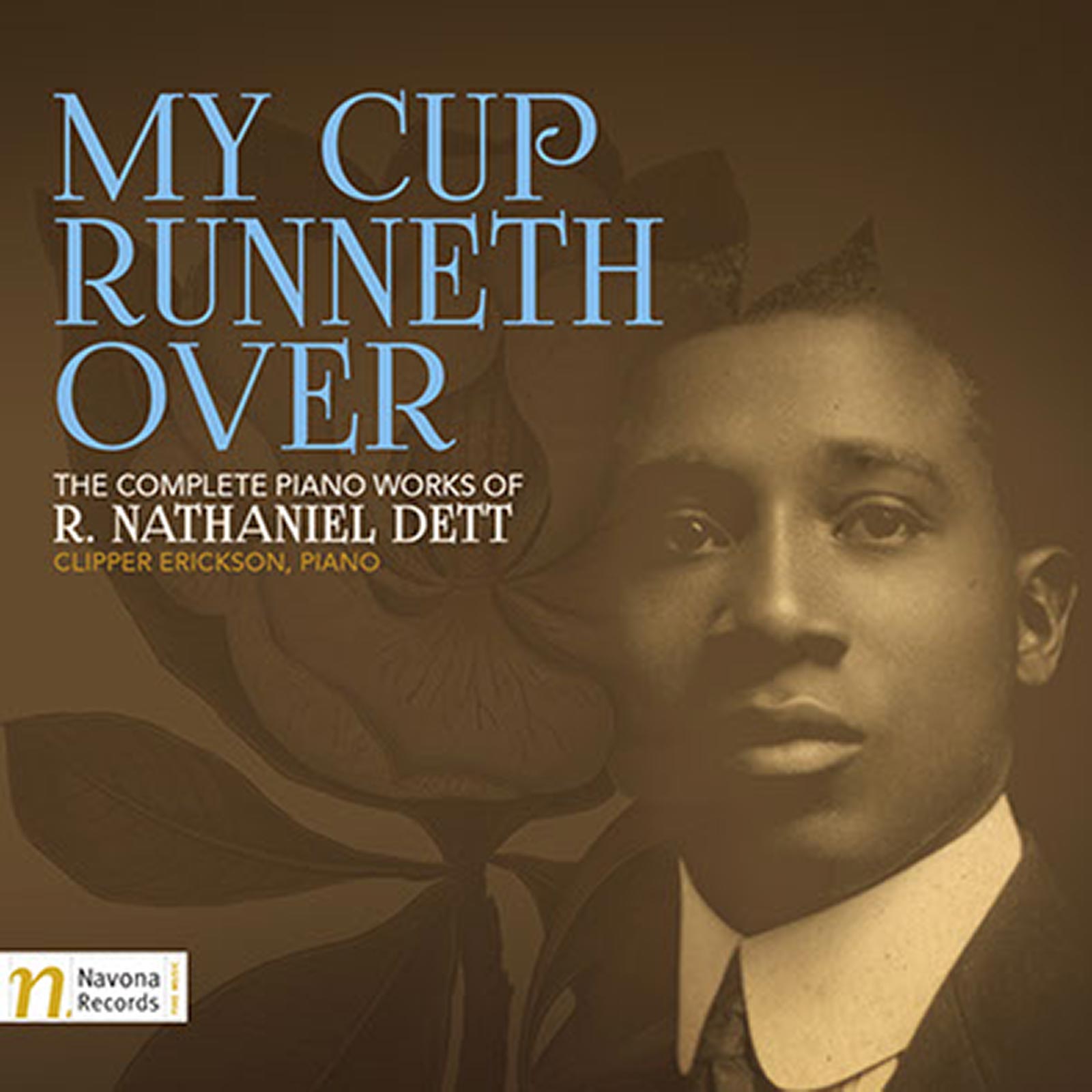

PARMA is pleased to celebrate the 10th anniversary of pianist Clipper Erickson’s MY CUP RUNNETH OVER, the first complete collection of Nathaniel Dett’s piano works, this November.
Named the 2016 Gramophone critic’s choice, this Navona Records album represents a milestone for American music discography. Erickson’s performances on this album deliver some of the most significant music of early 20th-century America to the world, reminding us of the prominent role of African American spirituals and folk music in contemporary American art, culture, and philosophy.
“…this music is simply wonderful, while Erickson’s idiomatic, colourful, technically adroit and caring interpretations do the repertoire full justice,” said Gramophone.
“No serious aficionado of the history of American piano music can afford to miss it.”
A composer, pianist, teacher, poet, and writer, Dett is regarded as one of the most important musicians in American history, lauded in his lifetime as the first American composer to fuse African American folk idioms with the European art music tradition in a sophisticated way.
“The Complete Piano Works of R. Nathaniel Dett is dedicated to the memory of George Schermerhorn, a great musician, teacher, and humanitarian, who made my first album recording possible and was a truly great friend,” says Erickson.
“The title of this album refers to Dett’s final work, Madrigal Divine, which is a pianistic setting of Psalm 23. It also evokes the incredible creative breadth and vision of this great man, as well as his dreams for a better world for humankind — his cup truly did run over.”
Erickson celebrates the 10th Anniversary of MY CUP RUNNETH OVER on November 23, 2025 with a live performance at St. Michaels Episcopal Church in Trenton NJ.
We connected with Erickson to dive deeper into the origins of this celebrated Navona Records release, learn about his early hopes for the project, and explore its long-lasting impact.
What first drew you to R. Nathaniel Dett’s piano works, and what inspired you to record the complete piano works rather than a selection?
CE: I’ve always been curious about music that is outside the canon of what the classical music world has decided are the “great composers” — I think I got that from my teacher, the great British pianist John Ogdon, who also played a tremendous amount of repertoire that others don’t play.
I first came in contact with Dett’s music through a friend who is a wonderful pianist and gospel choir director, Donald Dumpson. At some point in the mid-1990s I asked him for recommendations of piano music by African-descent composers; he turned me on to Coleridge-Taylor, Burleigh, John Work, and the Juba Dance of Nathaniel Dett. I bought Dett’s collected works — a 200+ page volume, and started playing through the rest of the book. So much was unfolding under my hands, the mastery of piano sonority and color, the luscious harmonies and melodies inflected by spirituals. I performed one of the six suites, In the Bottoms (the only one heard occasionally), but the others kept saying something personal to me — the desire to be heard, felt and brought to life in sound.
Years later, when finishing my D.M.A. at Temple University in Philadelphia, I needed to find a thesis topic. Some professors suggested I stick to something “important” or “noteworthy,” not a figure like Dett. Unsure of what to do, I ordered a biography of Dett and in the mail came a used copy signed by the author. That was the sign — this was my path. When the thesis was done, I wanted to do more — get this great music out to a wider audience. Since the music was composed at every period of Dett’s life, reflecting the experience of a rich and difficult life, I thought it best to include everything to give the full picture of the breadth of Dett’s imagination.
How did your knowledge of Dett’s biography and philosophical ideas influence your musical choices in dynamics, articulation, or overall narrative arcs of the works?
CE: In my creative process, it is essential to understand the history of the time of the creator’s life. The interpreter needs to understand the person, their thoughts, personality, above all their experience. Musical creation is an expression of that life experience, so if a performer doesn’t have an idea of what that is then they are just reproducing notes. That’s essential whether it’s Dett or Beethoven, in my opinion. Spirituals were the overriding influence on Dett’s work, so it was important for me to get to know them, the passion, the emotional progression. Dett is also very involved in musical imagery and uses pianistic color expertly to create it, so I needed to work at getting the most beautiful sound I could from the instrument. Rhythm also profoundly underpins almost everything Dett wrote, in a way rather rare in the 19th century piano music that preceded him. Understanding the motion and dance aspect of the music was important to me.
What do you think remains under-recognized or misunderstood about Dett’s contribution to American music, particularly in piano literature?
CE: Dett’s music occupies a rather anomalous position in piano literature. There is very little influence of jazz on him — everyone seems to take it for granted that a Black composer has to write jazz or something like it. It’s also intensely personal and poetic, written in a time that was moving away from that. Except for a handful of pieces, it shies away from virtuosity. Much of what pianists play is governed by competition culture so it’s not naturally attractive to young players who are looking for pieces to show their stuff.
As a Black composer not writing jazz, an innately Romantic personality in an anti-Romantic age, he doesn’t fit neatly in a category. And conservatory trained musicians are steeped in categories — endless programs and auditions representing four style periods. But not fitting into a category is a lot of what attracts me to his music. Audiences aren’t encumbered by all this — they just love the music.
When the album was released, what were your hopes for its reception? Have there been surprises in how it was received?
CE: I hoped that it would attract some critical attention and result in a wider listener base for the music. I didn’t expect that it would be recognized as a Critic’s Choice by Gramophone UK — one of the top reviewing publications in the world. And be reviewed in so many diverse places — Black Grooves, a review in Catalan — and featured on radio all over. I especially didn’t expect how long it would continue to be aired and streamed. I still hear from friends all over that they heard my Dett album on radio from wherever they are. Usually, albums have a short shelf life — they get attention for a while and then are mostly forgotten. That’s why I wanted to commemorate the 10th anniversary of the release, as well as give thanks to so many that made it possible — my recording engineer Dirk Fischer, the great people at PARMA, and so many friends that helped with the funding.
What has been the long-term impact of this project over the past 10 years (for yourself, for Dett’s legacy, for audiences)? Where do you hope it will go from here?
CE: The impact has been that so many more listeners enjoy it now, and they are curious to hear the other great choral and vocal music that Dett wrote. Now his oratorio, The Ordering of Moses, has had several performances, including by Oberlin Conservatory at Carnegie. Most of all, that young people are listening to and playing it — that will ensure that it keeps going and gets performed. Going ahead, I hope that Dett’s music will continue to grow in people’s knowledge of great music, that it will continue to inspire, move, and give joy, and that his vision of a better world of human harmony and love, as expressed particularly in his later work, will one day be a reality.
What does it mean to you personally and professionally to see this project reach its 10th anniversary?
CE: I feel that, wherever my life and career go from here out, I’ve made a contribution to the music world that will outlast me. That’s really the greatest accomplishment that anyone could aspire to and I am extremely grateful for that.