
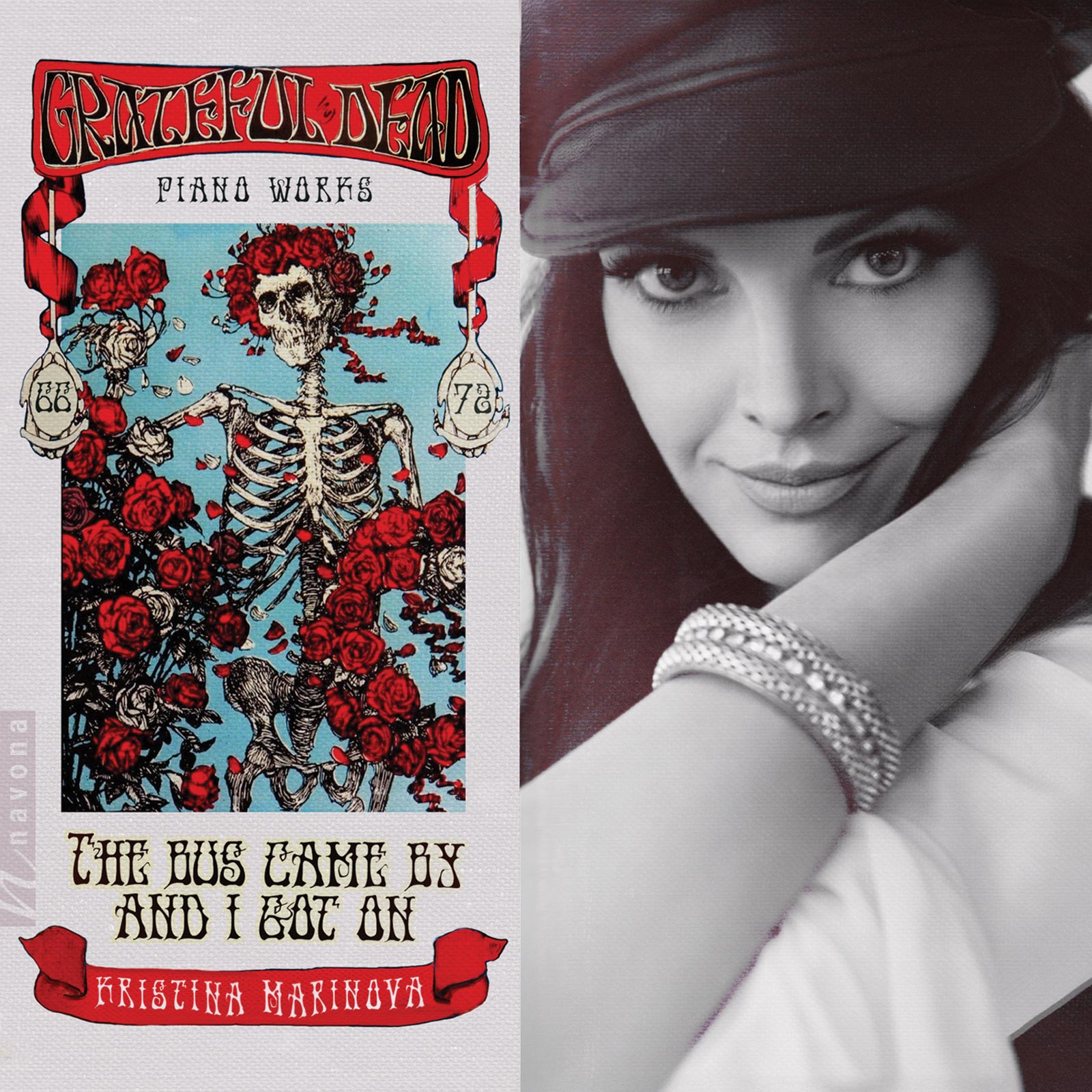
It’s not every day you find a Steinway where a tie-dye tapestry might normally hang. But then again, the Grateful Dead were never about predictability. Somewhere between the swirl of incense and the silence of a concert hall, pianist Kristina Marinova has carved out a new space for Deadheads and classical music fans alike.
Her new album, THE BUS CAME BY AND I GOT ON, takes the music once jammed out in open fields and smoke-filled arenas and refracts it through the lens of solo piano — trading the roar of the crowd for the resonance of keys, without losing a trace of the soul.
The Navona Records release is a sonic tapestry of the Grateful Dead’s music with a devotee-pleasing setlist designed to replicate a Dead concert spanning their inception in 1966 to their award-winning and critically-acclaimed three-album Live European Tour in 1972.
With her reputation as “a feast for the ears” and someone who makes it clear that “music is like a message from God,” Marinova’s just the person for the job, expertly translating mind-melting soundscapes for a single instrument.
Catching Up With Kristina Marinova

We recently connected with Marinova to learn about the inception of her classically-psychedelic album, the aspects of the Dead that best lend themselves to classical music, and the intersections she discovered along the way.
Is there a particular song or moment in the repertoire that resonates with you most deeply—and why?
There is so much merit and complexity to this music, where do I start?! Firstly, it is important to note and explain my choice of recording the early period (1966–1972) of the Grateful Dead’s repertoire. This era is significant, because it really pinpoints an important evolution of bands’ sound development and forms the transformative power of the music into a higher dimension of awareness. There is a very clever and attractive use of dissonance in the music here. I can clearly find classical theory and influences in the pursuit of the band’s expressive dynamics. The uniqueness of noise as a musical statement. The discord of each member’s individual playing styles. The collaboration and comradeship of musical choices made, where each member is fusing personal tastes with one goal in mind: to deliver communion which serves the music. Garcia has said, “When you’re working in a band, you have to try to let everybody have his own voice the way he best sees it. There are always going to be things that create friction…”
There are so many songs from this period that I absolutely love, but I am particularly fond of The Other One and Morning Dew for their symphonic architecture which resembles the classical sonata form. These are the two pieces (which I have recorded so far) that allow space for the most musical freedom and artistic expression. The workings of The Other One are remarkably similar to the techniques of the classical composers Schumann, Beethoven, Wagner, and Mahler. The Other One also introduces ideas from the work on the spatial music of Charles Ives, where the composer is gathering mental impressions of a place and concepts of thought passing through time and space. The early years of development should be noted, because one can hear the strong influence of Ives on Lesh, described as “fantastical flux of sound,” reminding him of a “musical stream of consciousness, like the sound of the inside of your mind…all this flux of feeling and thought.” All of these idioms and influences are observed in The Other One in its unique style some call psychedelic, accentuating the unexpected and surprising elements of music making and performance. In my mind, it is one of the songs in the Dead’s extensive repertoire (along with Dark Star) where the classical influence is most obvious. There are instances where you hear for a brief moment how the music could be transcribed right into a 19th century string quartet. There is a riff where Bobby plays and Jerry mirrors with a volume pedal, reminiscent of strings. The piece is both evocative and mystical, depicting immersive soundscapes of psychedelic atmosphere where one delves into the idea of simultaneity of existential experience with a running stream of overlapping thoughts through the mind without a point of focus. Between 1966 and 1972, The Other One stands as a monument of transformation from a jug/blues band to helping to define a generation.
Continuing on through the pieces, Morning Dew and Broke Down Palace both offer profound emotional depth which interprets perfectly to the expressive timbres of a full orchestra. Two songs depicting death written in major keys? Wow! Translating that concept into a piano transcription was challenging as most classical composers used minor keys to depict despair and inflict sadness. When we play in major keys, we can’t help it — the music sounds happy. Here comes the unprecedented gift of the Grateful Dead to bring humoresque answers to the existential questions; darkness to light; to lift up the voices of hope; to sing from the depths of innocence that has been lost, giving the wanderer a sense of homecoming and arrival to reach self realisation. They take us right to the soul of ourselves. It suddenly dawned on me during the course of my efforts over these past two years that these songs are not about fatality and the end, but rather songs of hope, life, love, and continuity. The life/death-major/minor is not the same as the one we hear in Schubert. With the Grateful Dead, we get a bit of a sense of mischief.
Another personal favorite is the anthem of Uncle John’s Band. There are numerous interesting technical elements in this song that are deceptive in their simplicity. The close harmonies and irregular rhythms of Bulgarian folk music (I am Bulgarian) influenced Jerry’s music choices in this song. Jerry drew inspiration from listening to a Bulgarian Women’s choir performance, where he heard a melodic phrase he admired which he incorporated into the song. Particularly interesting is the uneven time signature change going from 4 into 3 for two measures, which doesn’t often occur in classical writing and can also create rhythmic disorientation and discomfort. It took some time to make that rhythmic switch work and sound organic.
I also enjoyed folk influences in the music of El Paso. In this piece, one can feel the strong synergy of the continuous rhythmic pulse of early classical music interweaved with later Americana style. Jerry was a prodigy who bridged classical Americana with contemporary rock. The song gives the feeling of riding on a carousel of American tunes with a kaleidoscopic whirl of sound. The Dead’s incorporation of folk, bluegrass, and root music offers a rich palette of melodies and rhythms for classical adaptation. Jerry’s influences from bluegrass and his early banjo playing was both fluid and intense which made a difference in his unique guitar sound and lush lyrical expression. His fingerpicking style along with Bobby’s “unique rhythm” guitar translates beautifully in the solo-counterpoint piano passages.
What elements of the Dead’s music lend themselves most naturally to classical interpretation — and which were more challenging to adapt?
Interpreting the music of the band required serious research, musical growth, and commitment to the understanding of the varieties and choices of musical styles which the band made. Their sound is characterised by eclecticism that fuels from different stages of the American musical landscape. This melting pot of genres represented under a single umbrella was evident from the group’s inception and a result of the varying musical spheres and scenes in which the musicians had sprung from. The different sets of skills, techniques, and sensibilities that each of the players brought formed the foundation on which the band and their music was built.
At the same time, the influence of the classical composers Mahler, Stravinsky, Ives, as well as the jazz icons such as Coltrane and Miles Davis are clearly evident in the music. The uniqueness of the Dead’s sound derives from its distinctive texture with the emphasis on polyphony. This is highly unusual for contemporary rock music at that time where you heard, almost without exception, a rhythm section working with a lead guitar. The Grateful Dead’s juxtaposition of melodic materials can be compared to the compositional technique of Bach. With the band, one heard six part polyphony being improvised simultaneously — every player played a disparate unique part, but played it as one universe, communicating through the same language.
The band style of simultaneous improvisation is grounded in ensemble spontaneity and collective awareness. This element is difficult to transcribe and replicate in a structured classical performance format because it is driven on the wave of momentum. During the work process, I listened to concerts from all the various eras in order to distill the main aspects of the music. I call it: “the skeleton.” Transitions and bridges between songs are also period specific and change stylistically through time. The band’s improvisational style varied throughout their career, posing a challenge for composers seeking to capture a consistent essence in more classically structured and time honored transcriptions, such as orchestra. One important point to make was really paying attention to the chord inversions which really portrays the style of Bobby’s guitar playing.
Have you found any parallels between the harmonic language or structure of the Grateful Dead’s music and classical composers along your journey?
The Grateful Dead’s harmonic language and structure, while rooted in rock and blues, drew inspiration from classical music, particularly through Phil Lesh’s compositional and classical background. It is important to say that in the early period Phil was very involved with classical conservatory style composition, which had a major influence on the sound of the band and played a pivotal role in their improvisational style. Lesh also treated the bass as a soloistic lead instrument. It is important to show that in the early years the band was influenced by the avant-garde, 12 tone, and serialism. Polytonality; atonality; tone clusters; music of chance; statistical composition; permutation; add-a-part, practical-joke, and improvisatory music. These influences are also evident in their use of modal harmony, melodic basslines, counterpoint, and complex harmonic structures, contributing to their unique and improvisational sound. When the band first formed, they didn’t perceive their ensemble as a rock band. When talking about Lesh, Peter Albin said, “I’d see these charts that Lesh had written… Like a symphony for 50 guitars. They were all circular… How do you read this?” In 1967, Garcia added “He got into modern forms of music, serial music and 12-tone music, and finally electronic music, and he composed these monster things… I’d come over and he’d have these monster pieces of score paper and he’d be working away in pen, the notes coming out of his head onto the paper, these things for like 12 orchestras!”
Parallel to classical composers, the style of performance is improvisational, however there is a distinct structure and form to it and the improvisation and transitions by the band are by choice. In its execution it almost sounds precomposed. In classical music the bass has a harmonic, melodic, and voice-leading function. Phil often played counterpoint to Jerry’s lead guitar lines, creating melodic lines that intertwined with the rest of instruments. The voice leading in the interpretation of his part is very important as well as the interesting chord inversions in Bobby’s lines. Phil, influenced by his classical background, treated the bass as a lead instrument and invented a whole new approach to the bass adding an innovative richness and depth to the Grateful Dead’s sound.
The early forms of classical music and certain folk traditions, utilize modes and pentatonic scales. The Grateful Dead frequently employed modal improvisation, where musicians improvise over a single chord or pair of chords as a “tonal key center,” rather than clinging to rigid chord progressions. They often used and improvised on scales like the Mixolydian, Dorian, and Lydian modes as well as the pentatonic scale. Knowing and playing on the harmonic language of the songs and discovering the modal centers offers that special and absolutely unique flavor of the Dead’s music.